Work / Case study
How we built Brook: uptime monitoring for voice AI agents
Voice AI agents now answer sales lines, support desks and booking numbers. When one stops picking up, nobody inside the business notices until callers complain. Brook is the product we built to catch that moment first, by calling the agent the way a real customer would.
- Product
- Brook
- Built and run by
- LoopLabs
- Status
- Live in beta
- Website
- brook.talk ↗
The problem: a voice agent can fail without anyone noticing
A voice AI agent is only useful if it answers. Businesses are putting them on the phone lines that matter most, and when one goes silent, answers slowly or times out, the caller does not file a bug report. They hang up and call someone else.
The usual monitoring tools do not help much here. They check whether a server responds to a request. They cannot tell you whether the agent actually picked up the phone, or whether what it said made sense to a caller. A line can be “up” on every dashboard and still be useless to customers.
We wanted a simple answer to one question, at any moment of the day: is my voice agent good for customers right now?
The approach: call the agent like a customer would
Brook does not plug into the agent's code. It works from the outside, the same way a customer does. A team adds the phone number their agent answers, and Brook calls it on a schedule, around the clock. Because it only needs the number, it works with any carrier and any voice platform, with no SDK to install.
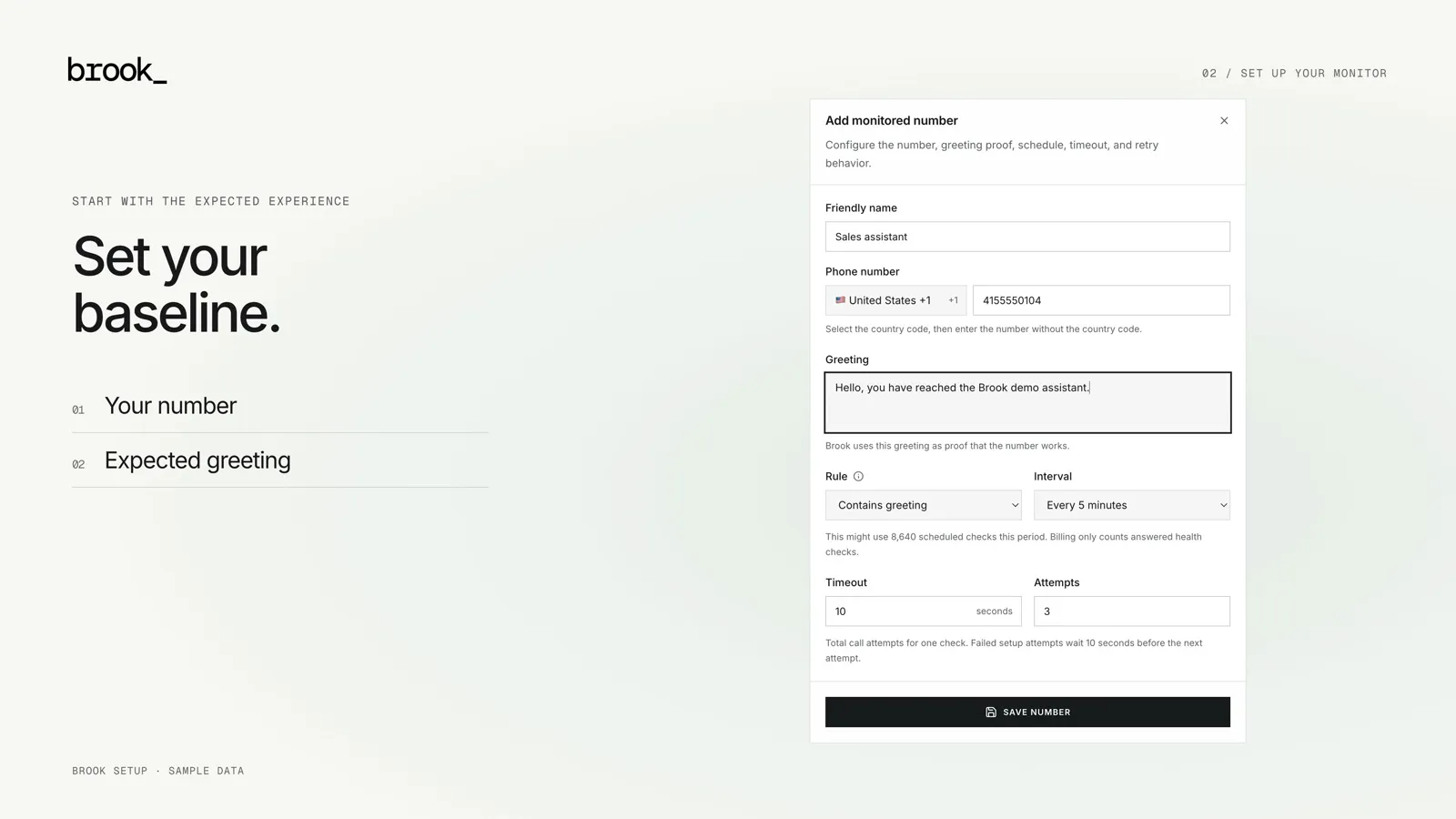
Setup takes a couple of minutes. Each monitored number gets a friendly name, the phone number with its country code, and the greeting the agent is expected to say. That greeting becomes the proof that the line works. The team then picks a rule for checking it, how often to call (every 5, 15, 30 or 60 minutes), how long to wait for an answer, and how many attempts to make before a check counts as failed.
Catching the failures that matter
A connected call is not the same as an answered one. While building Brook we mapped out the different ways a voice line can fail, because each one needs a different response from the team:
No answer. The call never rings through. Busy line. The number is unavailable or at capacity. Silence. The call connects, but the agent never says anything. Greeting mismatch. Something answered, but it was not the agent: a voicemail box, a fallback recording or the wrong system entirely.
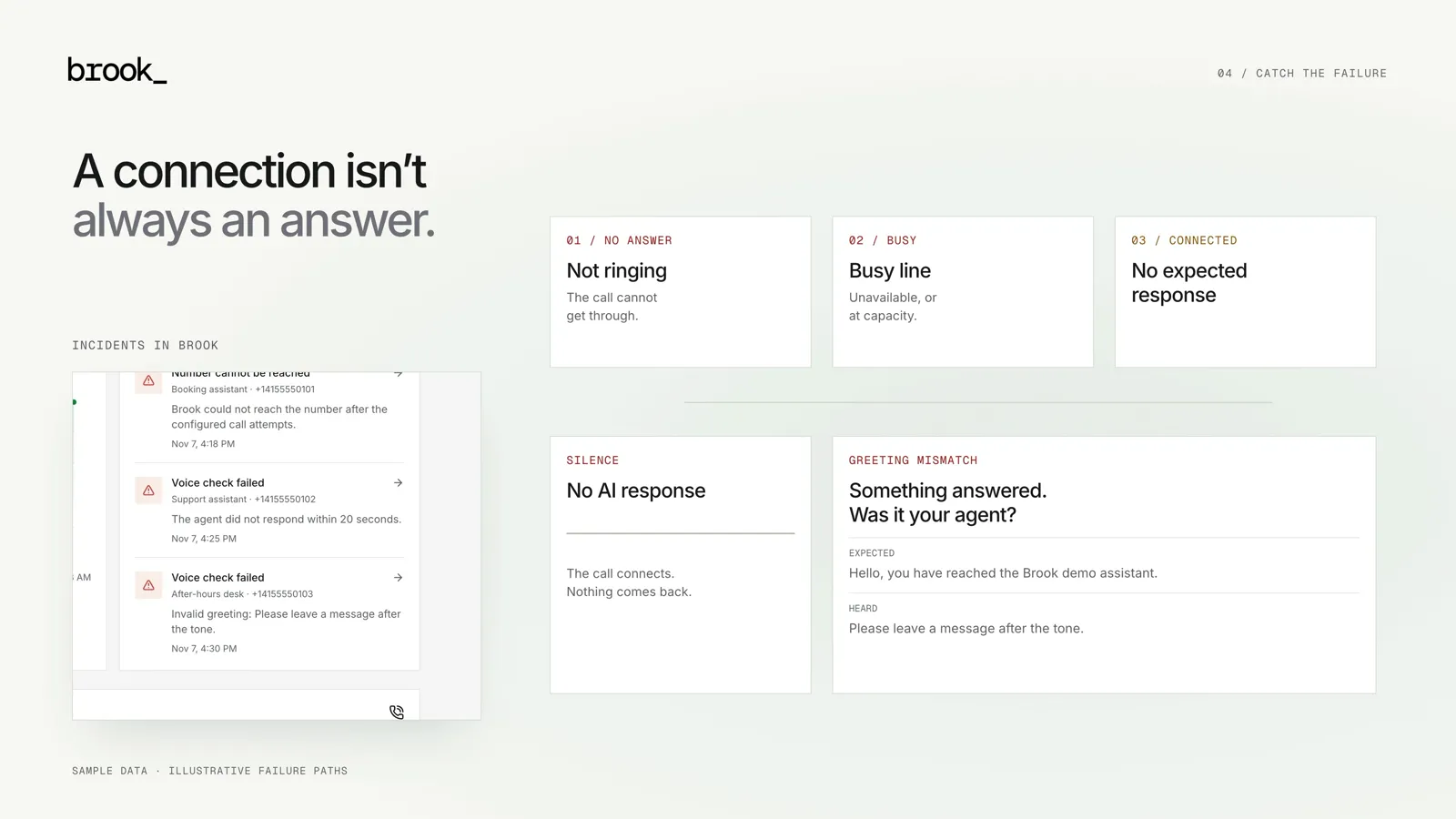
That last case is the one ordinary monitoring misses completely. If an agent's provider falls over and calls start landing on a generic message, the line is technically answering. Brook compares what it heard with the greeting it expected, and flags the difference.
From every call to a clear verdict
Brook records the agent's first spoken response on each call, so the team can hear exactly what a caller heard, and times how long the agent took to say it. Every test call then resolves to one of three states:
Operational means the agent picked up quickly and responded within the team's latency target. Degraded means it is still answering, but the first response is slower than the target. Down means no answer, dead air or a timeout.
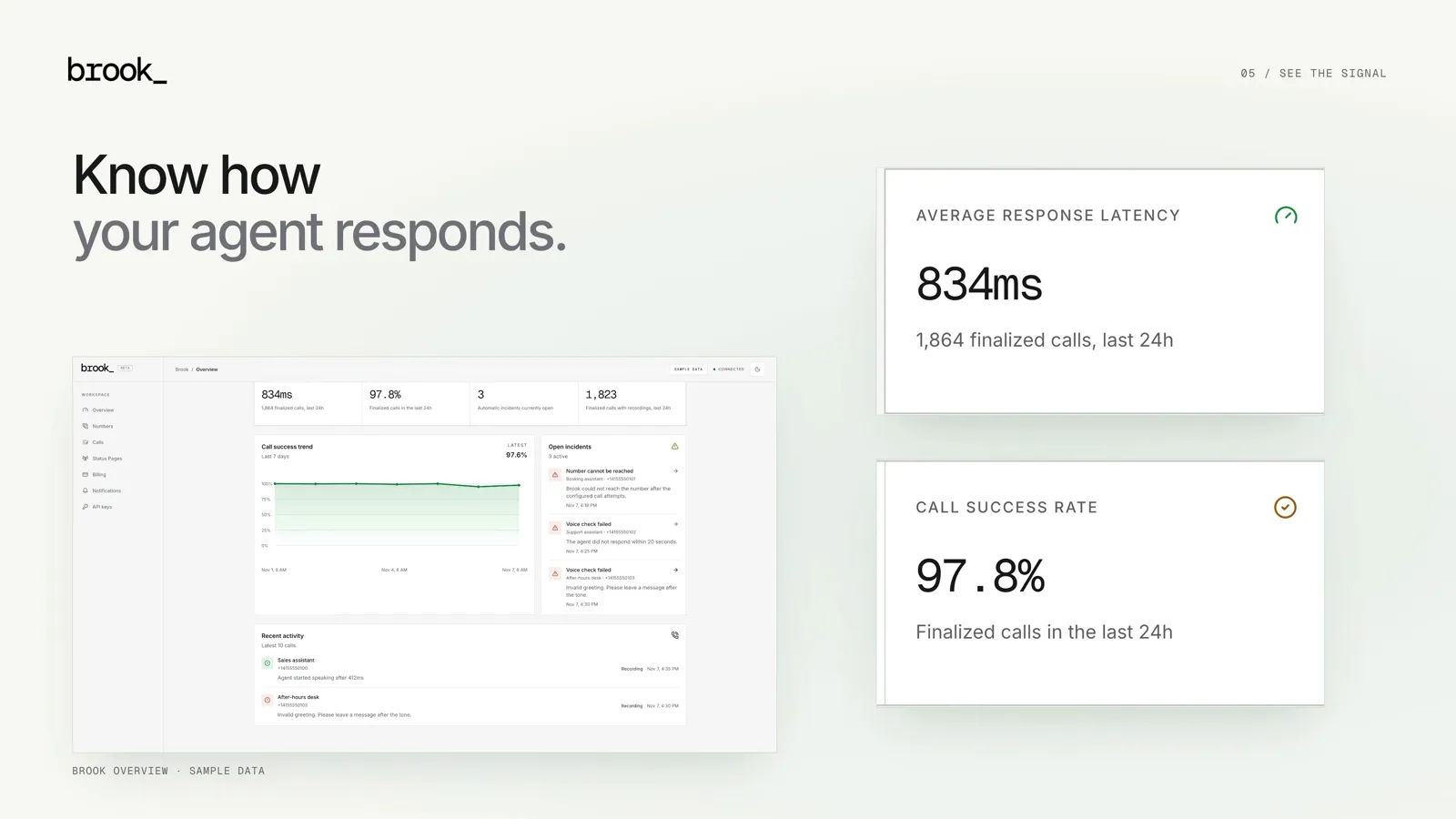
We kept it to those three words on purpose. The people who need to act on a failing phone line are often not engineers, and a verdict anyone can read is more useful than a chart only one person understands.
Telling the right people, in the right place
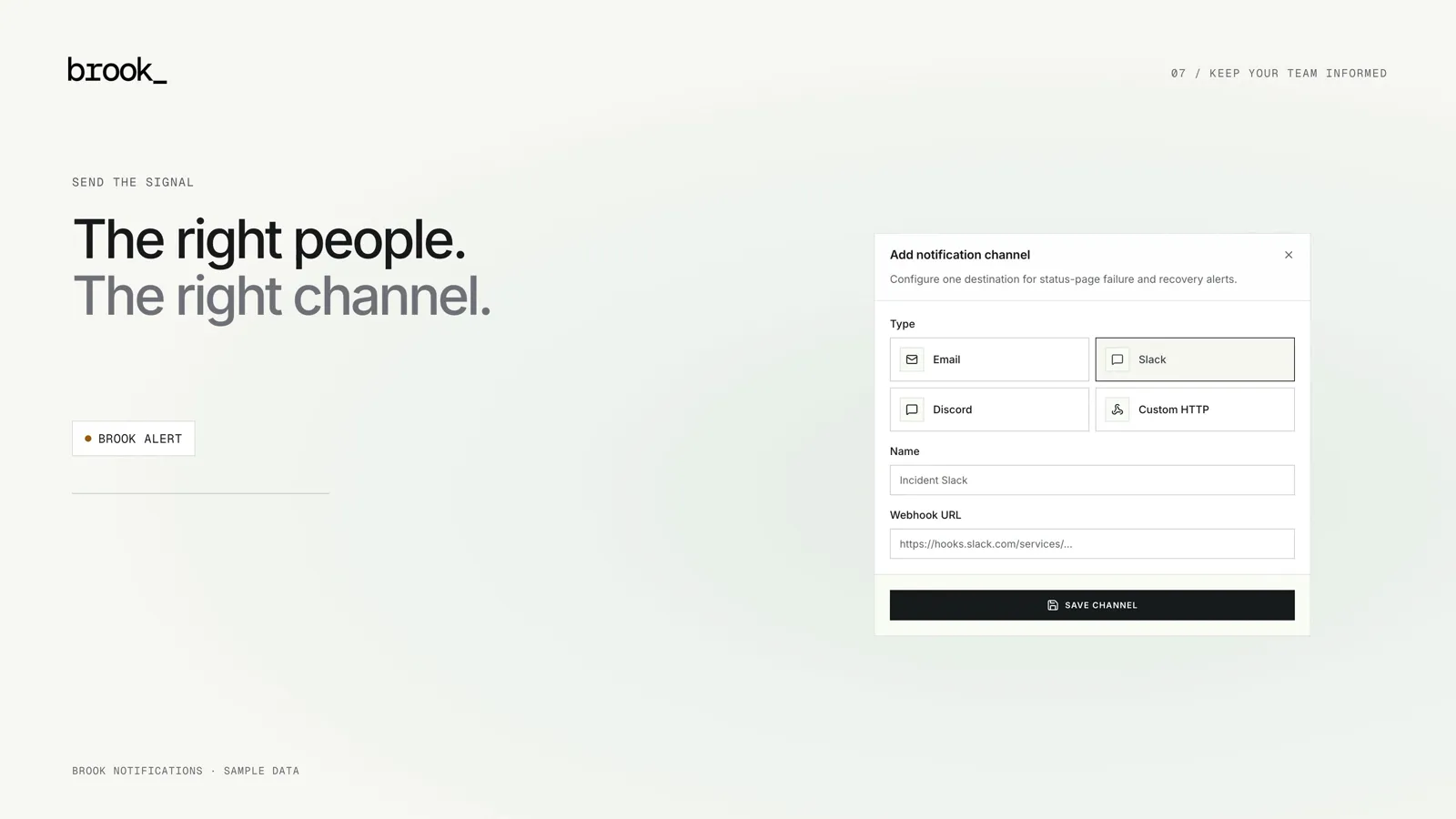
A monitor is only as good as its alerts. Brook sends them to email, Slack, Discord or any custom HTTP endpoint the moment a check fails, and again when the line recovers. Teams can also publish a branded public status page that shows live uptime for each of their voice agents.
The engineering behind it
Under the simple interface, Brook is a telephony system that has to run continuously. Scheduled outbound calls go to many numbers across different carriers, each one recorded and timed. Every check runs to a configured timeout with retries, so a single dropped call does not raise a false alarm, while a real outage is caught quickly.
For teams that want to automate their checks, Brook has an API, webhooks, carrier documentation and test suites. Call recordings are encrypted at rest and can be deleted at any time, and SOC 2 Type II certification is in progress.
What comes next
Today Brook checks that an agent answers, and answers correctly. The roadmap goes further into how well it handles a real conversation: simulated callers with background noise, choppy audio and frustrated customers; full transcripts of every test call; speech latency tracked turn by turn rather than only on the first response; and defined scenarios with expected answers, scored automatically to catch wrong or off-policy replies.
What Brook means for businesses building voice agents
We build AI applications that answer calls and messages for businesses, and Brook is how we learned where those systems break in production. That experience goes into every agent we deliver: the monitoring, the alerts and the clear status that let a team trust it day to day, and know when to step in before a customer has to tell them.
If you are planning an AI agent for your phone lines or customer messages, see how we build AI-powered applications, or talk to us about the process you want to start with.