Work / Case study
How we built Fern: AI study sessions grounded in your own notes
Most study tools hand students more material than they can get through. Fern does the opposite. It takes a topic or a set of notes, plus the minutes a student actually has, and builds one focused session that fits. We designed and built it, and we run it.
- Product
- Fern
- Built and run by
- LoopLabs
- Status
- Live, free to start
- Website
- fern.ph ↗
The problem: deciding how to study eats the time to study
Students rarely lack material. They have lecture notes, textbook chapters and past papers. What they lack is time, and a clear plan for using the little they have. A lot of that time goes on deciding what to do first.
AI study tools often make this worse. Ask for flashcards and you get two hundred of them. Ask for a summary and you get one that ignores what the course actually covered. And when generated content includes facts that are not in the source, it does more harm than good the night before an exam.
We set out to build something that respects the student's time and stays faithful to their material.
The approach: start from the time available
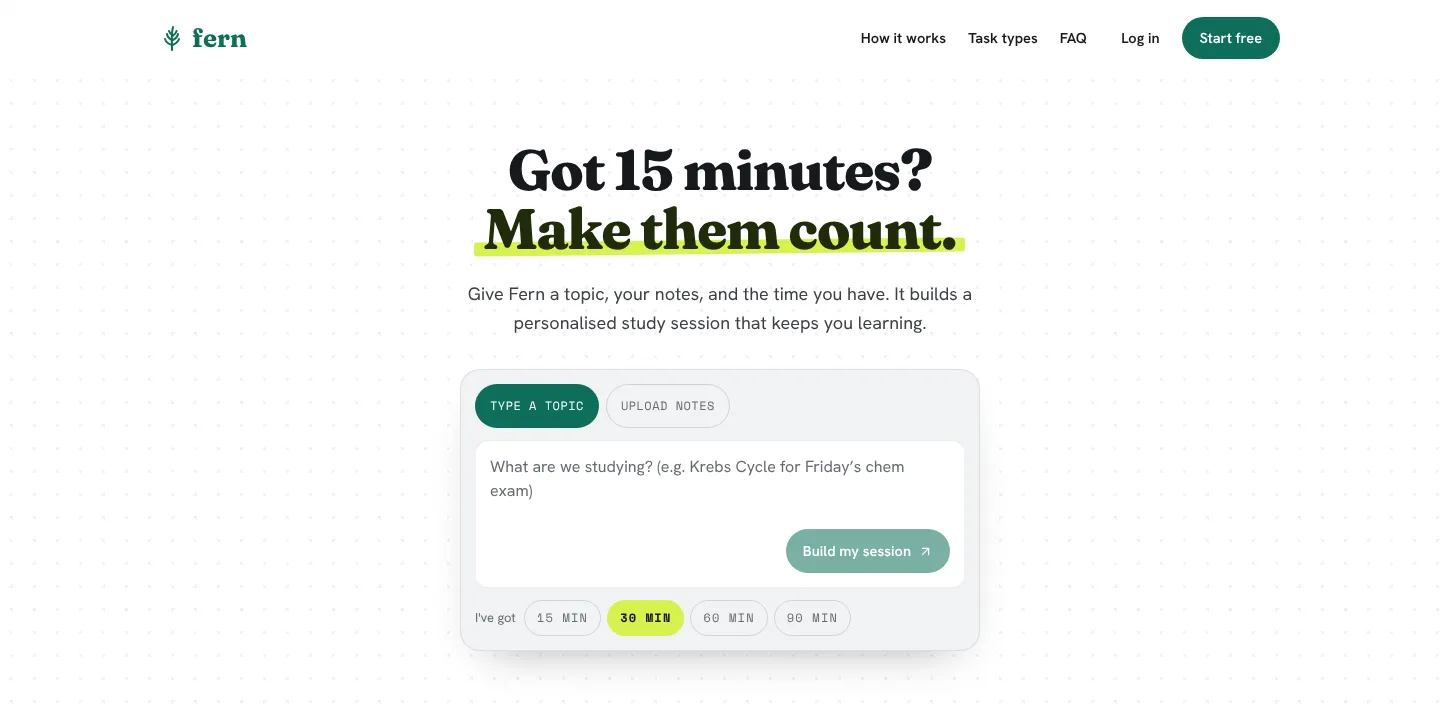
Fern asks for two things. The first is what to study: a topic typed in plain words, or the student's own notes as a PDF, a Word document, pasted text or a photo of a page. The second is how long they have, from fifteen minutes on the bus to ninety minutes before an exam.
From there, Fern builds a single session to work through from top to bottom. A fifteen minute session leans on a summary and quick self-testing. A ninety minute session has room for a mind map and a full practice exam. The student does not choose the tools; they just start at the top of the plan.
Six ways to study one topic
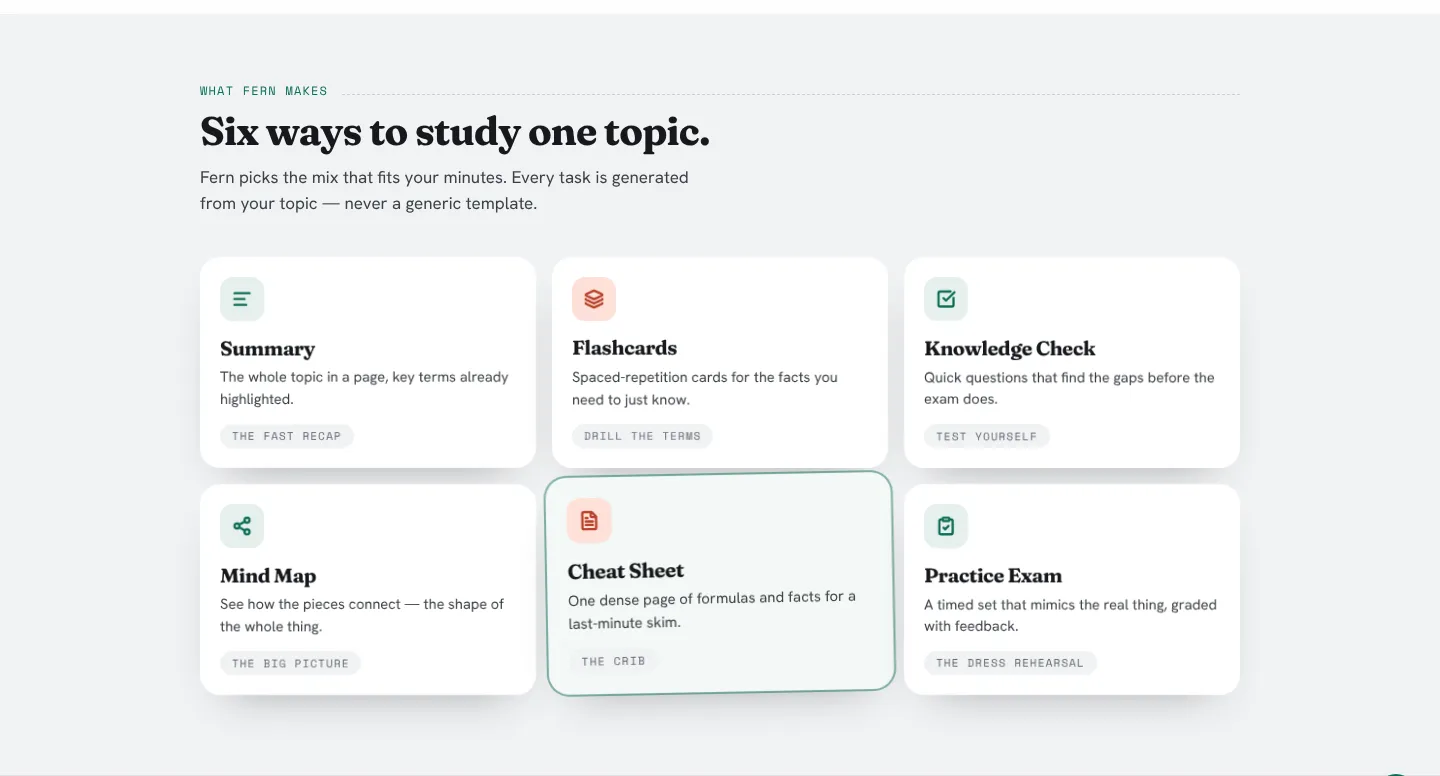
Fern can generate six core kinds of task, each built from the student's topic rather than a generic template: a one-page summary with key terms highlighted; flashcards with spaced repetition for the facts that must be memorised; a knowledge check that finds gaps before the exam does; a mind map that shows how the ideas connect; a dense cheat sheet for a last-minute skim; and a timed practice exam graded with feedback.
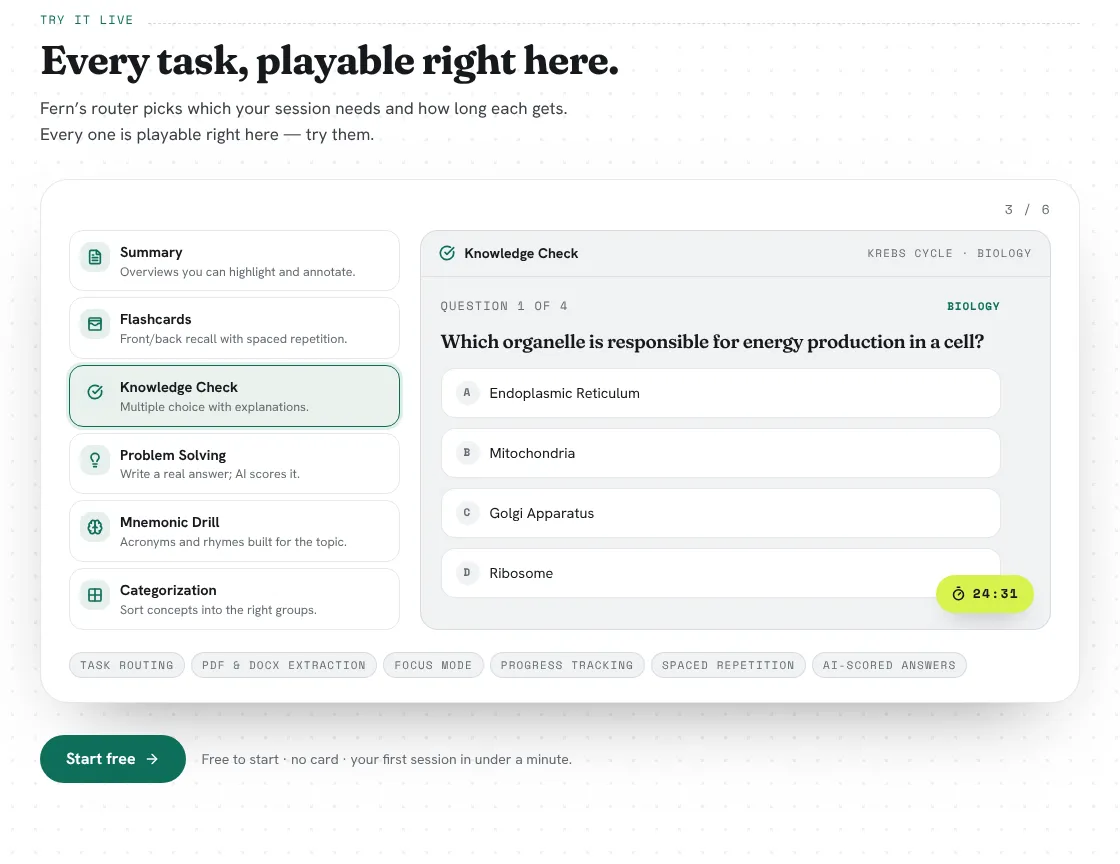
Alongside those, Fern includes problem solving, where the student writes a real answer and the AI scores it; mnemonic drills, with acronyms and rhymes built for the topic; and categorisation exercises that sort concepts into the right groups.
The engineering behind it
A router that plans the session
At the centre of Fern is a task router. For each topic it estimates the effort every task will take, then packs the session to the minutes available, favouring the tasks that improve recall most for that length of time. The mix also adapts to the subject: more flashcards for vocabulary, more practice problems for maths.
Generation grounded in the source
Accuracy was the requirement we cared about most. Every task is generated from the material the student provides, and the key claims can be traced back to their notes. When a student uploads their own material, Fern stays inside it and does not invent facts that are not there.
One pipeline for every kind of document
Typed topics, PDFs, Word files, pasted text and photographed pages all go through the same extraction pipeline, which pulls out what matters before any task is generated.
Scoring written answers
Multiple choice only tests recognition. For problem solving, students write a full answer and the AI scores it against the material, with feedback on what was missing.
What Fern means for businesses
Fern is a study product, but the capabilities inside it are the ones operational businesses need. The same extraction that reads a textbook page can read supplier quotes, purchase orders, invoices and photographed forms. Grounding every answer in the source is how we build internal tools that answer questions from your own price lists, policies and records without making things up. And scoring written answers is the same skill used to review emails and requests before they reach a customer.
If your team spends hours reading documents and retyping what they say, see how we build internal AI tools, or talk to us about the process you want to start with.